
Hoke County Court Records After Arrest
Hoke County court records after a jail arrest start when the arrest becomes a criminal case. The Hoke County Detention Center can confirm public information about charges and conditions of release for a person held in the local jail, but the jail is not the court. The official detention page states that the facility does not set bond amounts, change court dates, render verdicts, or determine punishment. Those steps belong to judicial officials, the clerk, the District Attorney, and the courts.
That division matters when a Hoke County arrest is new. Jail inmate records are the better first source for current custody, booking name, jail-held charges, and release conditions. Jail roster mugshots are a separate booking-photo question, and Hoke County research did not locate a browser-based mugshot gallery. Court records after a jail arrest show the filed case, the charge status, hearing dates, and dispositions once the charge moves into the North Carolina court system.
The NC Judicial Branch Hoke County page is the court starting point for courthouse information, calendars, court-date tools, and the local eCourts rollout note. Hoke County is in Prosecutorial District 29, Superior Court District 29, and District Court District 29. The courthouse is at 304 N. Main Street in Raeford, and the Clerk of Superior Court can be reached at 910-878-4100. Local custody records come from the Hoke County Sheriff's Office, led by Sheriff Roderick Virgil.
Find Hoke County Court Records
Hoke County joined North Carolina eCourts in the October 2024 Track 6 rollout. After that point, public case lookup for Hoke County court records runs through the NC eCourts Portal, clerk public terminals, and clerk records channels. The online portal is useful for filed case information, hearings, documents that are public, and payments. If the person was just booked and no case appears yet, the jail information line may have the first public charge and release details before the court index catches up.
- Start with the person's full legal name, date of birth if known, arrest date, and any case or citation number from jail or court paperwork.
- Search the NC eCourts Portal Smart Search and use Hoke County as the location filter when the case should be local.
- Open the matching criminal case and read each listed charge, hearing date, case status, and public document entry.
- If the online record is missing, use a public self-service terminal at a clerk's office or call the Hoke County Clerk of Superior Court at 910-878-4100.
- For prosecutor questions, contact District Attorney District 29 at 910-266-4500. The DA prosecutes the case for the State, but staff may not give legal advice.
The NC eCourts Portal training materials describe search tools that matter in a Hoke County court records search after arrest. Smart Search can use a name or case number. Advanced filters may include location, party name, date of birth, case type, case status, and filing date range. Search Hearings can look for current calendars by party, case number, attorney, judicial officer, or courtroom.
North Carolina court-record instructions also point people to public terminals and the clerk for copies. The Judicial Branch warns that complete police reports may not be public court records and may instead be handled through discovery in a criminal case. That is why a Hoke County arrest can involve three different tracks: jail custody information, law-enforcement records, and court case records.
The NC Judicial Branch Hoke County court page shows the local court access route used after a jail arrest.
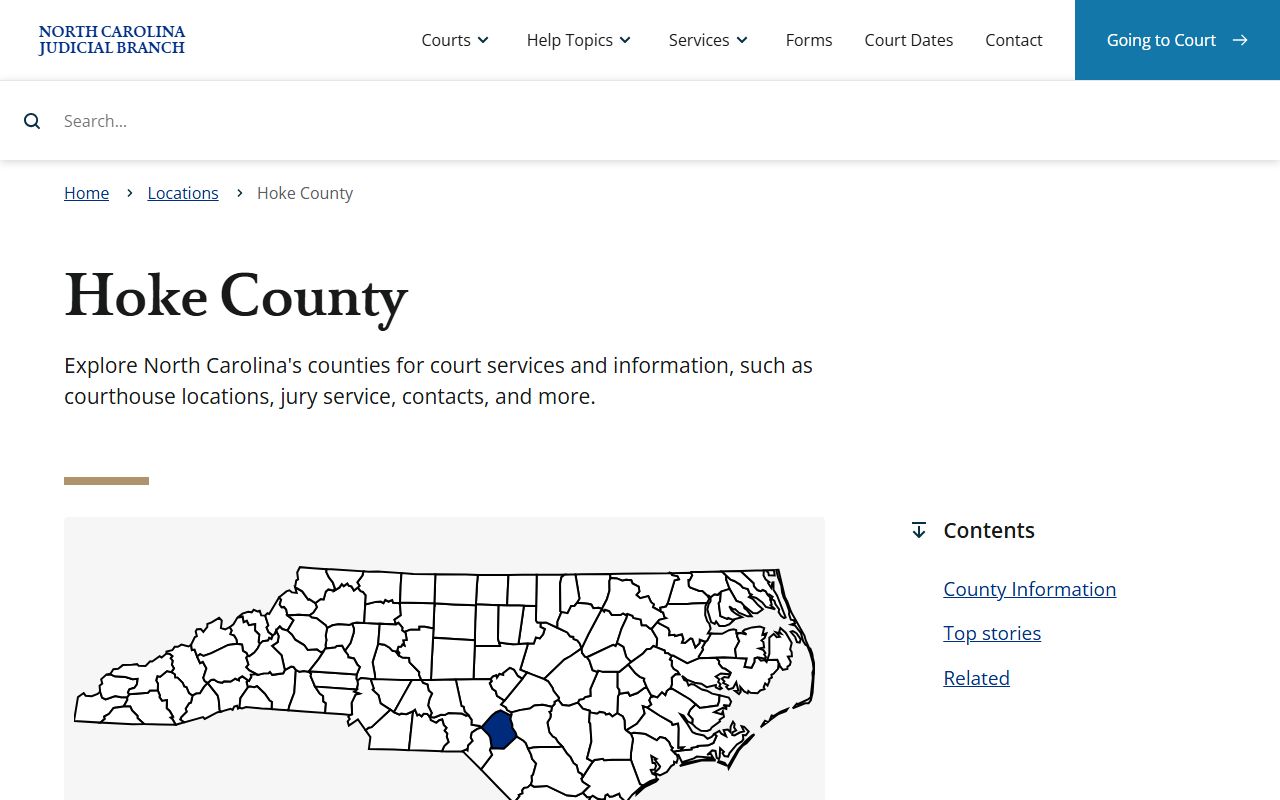
The Judicial Branch listing matters because Hoke County court records after arrest are searched through the court system, not through a jail mugshot gallery.
Hoke eCourts Search Fields
The eCourts Portal is not a Hoke County jail roster. It is the court case system. Use it after charges have been filed or calendared. A booking charge may appear by phone at the jail before the court case is indexed, and a court charge may later be amended, reduced, dismissed, or resolved by plea or trial. Search with enough detail to avoid mixing people with the same name.
| Field | Use | Notes for Hoke County |
|---|---|---|
| Smart Search | Search case information | Use a name, case number, citation, or other known identifier. |
| Location | Limit results by court location | Select Hoke County when the arrest and case are local. |
| Party Name | Narrow defendant matches | Portal training notes wildcard use with at least three last-name characters and one first-name character. |
| Date of Birth | Separate common names | Use only when known from reliable paperwork. |
| Case Type | Filter the court division | Criminal actions are the usual target after a jail arrest. |
| Case Status | Sort pending and disposed cases | Useful when checking whether a charge remains active. |
| Search Hearings | Find calendars and court dates | Search by case number, party, attorney, judicial officer, or courtroom. |
The NC eCourts Portal is the online interface for public Hoke County case lookup after the October 2024 eCourts transition.
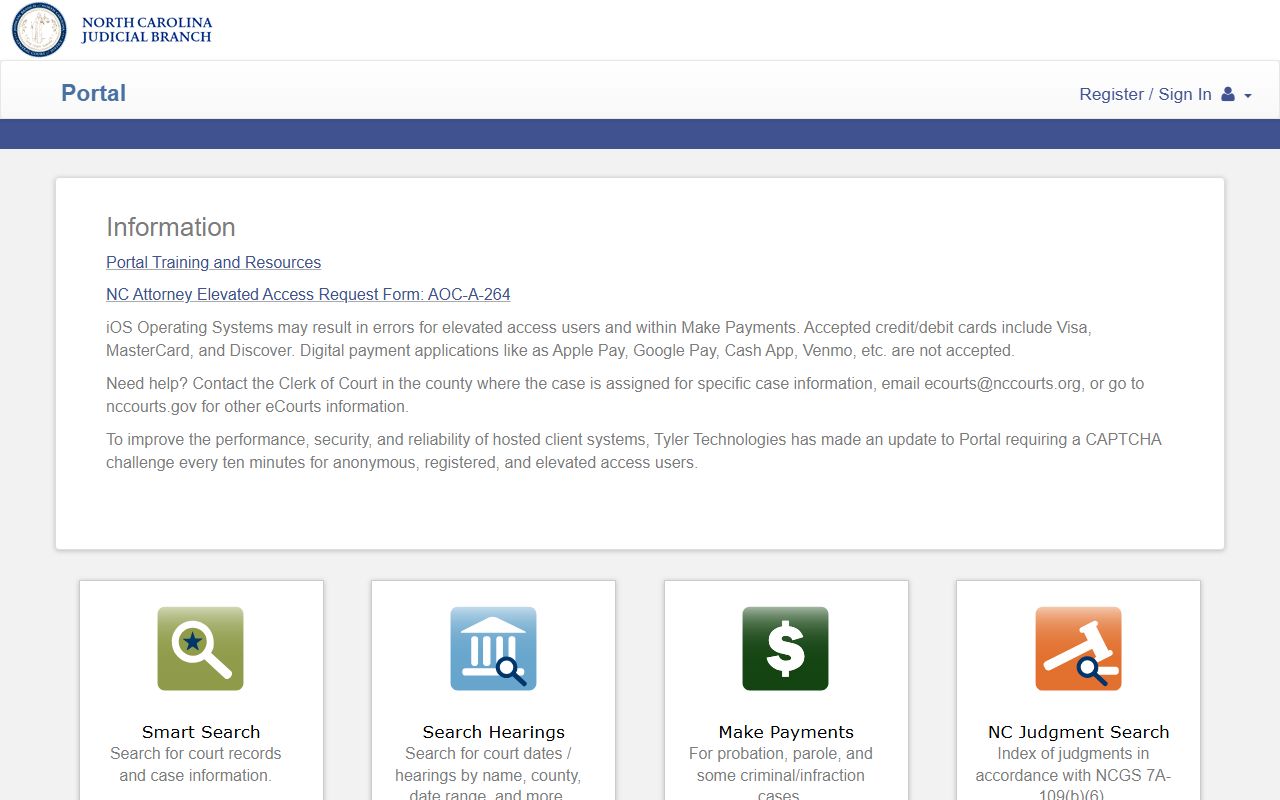
Those portal fields help connect a jail arrest to the court record without treating the booking record as the final case outcome.
Charges Filed After Arrest
A Hoke County arrest can begin with an officer's charge, a warrant, a citation, or another criminal process. The court record develops as the case is filed and prosecuted. North Carolina criminal procedure can include an initial appearance before a magistrate, a first appearance, a probable cause hearing in some felony cases, grand jury indictment for many felony cases, plea negotiations, trial, sentencing, and appeal. The prosecutor may add, reduce, amend, or dismiss charges as the case moves.
| Document or Event | What It Does | Where It Fits |
|---|---|---|
| Arrest warrant or criminal process | Authorizes arrest or charges a person with an alleged offense | May lead to booking at Hoke County Detention Center. |
| Magistrate paperwork | Records initial appearance and release conditions | Magistrates in Hoke County can be reached at 910-878-4191. |
| Criminal pleading | States the charge handled in court | Tracked in District Court or Superior Court depending on offense and stage. |
| Indictment | Grand jury felony charging document | Often moves or confirms a felony path in Superior Court. |
| Disposition entry | Shows dismissal, plea, verdict, or other case result | Should not be assumed from the booking charge alone. |
The charging record is the part to inspect when a Hoke County court records search after arrest is meant to answer what was actually filed in court. A jail booking can say what someone was booked on, while the court case can show what the prosecutor pursued and how the judge or court resolved each count.
Hoke Charge Status Terms
Charge status is the most important reason to check court records after a jail arrest. A booking charge is only an early entry in the process. A case can remain pending, be dismissed, be reduced to a lower offense, be amended, end in a conviction, end in a not-guilty verdict, or be affected by a failure to appear. The NC Judicial Branch criminal-case materials explain that missing court can trigger an order for arrest and can affect bond.
| Status | What It Means |
|---|---|
| Pending | The charge remains active and has not reached a final disposition. |
| Dismissed | The prosecutor or court ended that charge without a conviction on that count. |
| Reduced | The charge was resolved or changed to a lower charge. |
| Amended | The charge details changed after the original filing. |
| Convicted or guilty | A plea or verdict created a final criminal responsibility entry. |
| Not guilty | A trial verdict found the defendant not guilty on that charge. |
| FTA | Failure to appear, which may cause an order for arrest and bond consequences. |
For direct local contacts, the Hoke County court contact directory lists the Clerk of Superior Court, District Attorney, magistrates, and judges.
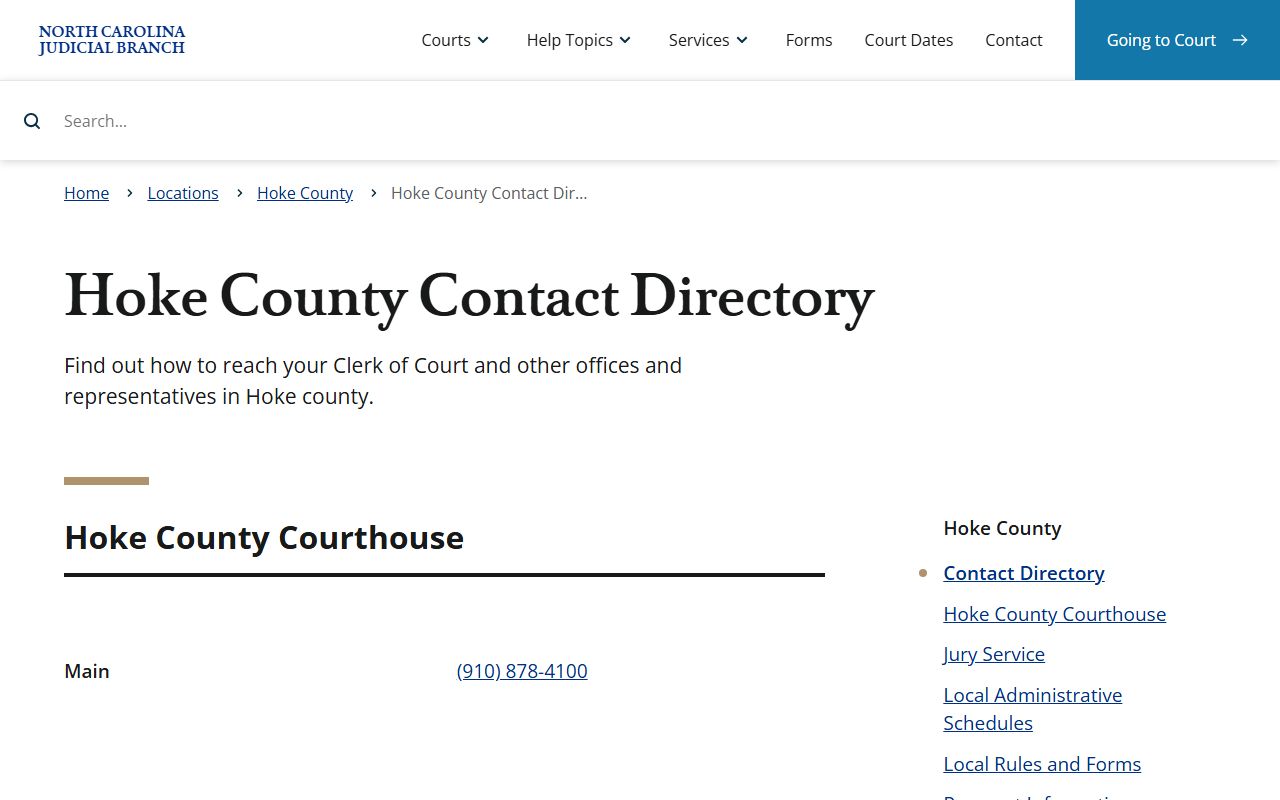
The directory is useful when a court record needs confirmation from the office that controls the case, bond hearing, or court calendar.
Bond and Release Records
Bond information after a Hoke County arrest sits between the jail and court systems. Under G.S. 15A-534, North Carolina pretrial release conditions can include a written promise to appear, custody release, unsecured bond, secured bond, or other lawful conditions. The jail may report public release conditions, but the jail does not set or change the bond. A magistrate or judge handles that judicial decision.
| Release Type | How It Works |
|---|---|
| Written promise | The defendant signs a promise to appear without paying money upfront. |
| Custody release | A person or organization agrees in writing to supervise the defendant. |
| Unsecured bond | No money is paid first, but money may be owed if the defendant fails to appear. |
| Secured bond | Money, property, or a surety must be posted before release. |
| Surety bond | A licensed bail bondsman or another surety guarantees the bond. |
| No-bond hold | Release is not available until further court action or another hold is resolved. |
G.S. 15A-601 governs the first appearance. It generally requires a first appearance before a district court judge within 72 hours after custody or at the first regular district court session in the county, whichever occurs first. If the courthouse is closed longer than 72 hours, the statute can allow up to 96 hours. At first appearance, rights and bond may be reviewed, which is why a bond amount shown near booking may not be the last bond entry in the court record.
Local bond contacts: Call Hoke County Detention Center at 910-875-5113 for public charge and release-condition information, and call Hoke County magistrates at 910-878-4191 for local judicial process questions.
Hoke Warrants and Arrests
No official browser-based Hoke County active-warrant search or public warrant list was located in the county sources reviewed. The Sheriff's Office pages include services such as incident report requests, patrol logs, anonymous tips, sex offender registry information, and the Sheriff's Office app, but the research did not find a public web warrant database. The app store listings also did not specifically advertise warrant search.
If a warrant or order for arrest leads to booking, the person may be held at Hoke County Detention Center until release conditions are met or court occurs. A warrant from another county can create a temporary hold or transport issue. Use the Hoke County Sheriff's Office main line at 910-875-5111 for warrant-related routing, the magistrates at 910-878-4191 for magistrate process, and the Clerk of Superior Court at 910-878-4100 for court case status. Emergency situations should use 911.
North Carolina public-records law does not make every warrant-related file public. G.S. 132-1.4 allows criminal investigative records and criminal intelligence records to be withheld, while preserving access to specified arrest information when a person is arrested, charged, or indicted.
Charges vs Convictions
A Hoke County arrest charge is not the same as a conviction. An arrest is an accusation and custody event. A court charge is the formal case matter. A conviction requires a guilty plea, guilty verdict, or other judgment that creates criminal responsibility. Court records after a jail arrest should be read charge by charge because one count can be dismissed while another remains pending or ends in conviction.
| Point of Comparison | Charge | Conviction |
|---|---|---|
| Stage | Accusation filed or handled in court | Final result from plea, verdict, or judgment |
| Proof level | May begin with probable cause or formal charging process | Requires proof beyond a reasonable doubt or a valid guilty plea |
| Where to check | Jail line for booking charge, then eCourts for filed charge | eCourts, clerk record, or certified court copy |
| Risk of confusion | Can change or disappear from the final case result | Should be tied to the specific count and disposition date |
Sealed vs Expunged Records
Restricted court records after an arrest require careful language. Sealed records are hidden from ordinary public access by law or court order. Expunction is a court process that removes eligible records from public access under a specific statute. North Carolina's G.S. 15A-145.5 provides expunction eligibility for certain nonviolent misdemeanors and felonies, but eligibility depends on the offense, prior record, waiting periods, and other legal conditions.
| Issue | Sealed | Expunged |
|---|---|---|
| Public visibility | Hidden from ordinary public inspection | Removed from public access if the court grants the petition |
| How it happens | By law, court rule, or court order | By petition and court order under eligible expunction law |
| Law-enforcement access | May still exist for limited official purposes | May still be available in narrow official contexts allowed by law |
| Hoke County route | Confirm with the Clerk of Superior Court | Use the court expunction process, often with legal advice |
An expunction order does not guarantee that private copies already scraped or republished elsewhere vanish at the same time. The practical route is to obtain the court order, then contact each record-holding agency or publisher that still shows the record. Hoke County court records should not be described as expunged unless the court has granted that relief.
Restricted Hoke Court Records
North Carolina law starts with broad public-record access. G.S. 132-1 defines public records broadly, including photographs and electronic records made or received by public agencies in public business. G.S. 132-6 requires custodians to allow inspection and copying at reasonable times and to provide copies as promptly as possible, subject to legal limits and fees.
Those public-record rules do not open every Hoke County arrest or court-related file. Juvenile records, sealed cases, expunged matters, restricted victim information, medical information, some domestic-violence safety details, and criminal investigative materials may be withheld or redacted. G.S. 132-1.4 is especially important for law-enforcement records because it excludes criminal investigation and intelligence records from the public-record definition while still making certain arrest information public.
Important: This resource is not a consumer reporting agency and may not be used for employment, credit, housing, insurance, or other FCRA-covered decisions.